PHYSICS - Intro to Forces
OPENING QUESTION: Work with your team to define the term 'Force' in a physics-ish kinda way
LEARNING TARGET: I will be able to sketch a basic force diagram during today's class
CALENDAR:
WORDS O' THE DAY:
- Force ("Push" or "Pull")
- Newton (kgm/s2)
═══════════════════════════
-
Newton's 1st Law ("An object will continue whatever it is currently doing unless acted on by an unbalanced force")
-
Newton's 3rd Law
-
(Short Version: "Forces ALWAYS come in pairs")
-
(Quick memory aid version: Noun1 Verb Noun2 | Noun2 Verb Noun1)
-
(Formal Version: For every force acting on one object, there is an equal and opposite force acting on a second object)
-
-
Force Diagram (A sketch showing ALL forces acting on an object)
-
Net Force Diagram (A sketch showing only the resulting (net) forces acting on an object)
FORMULAE OBJECTUS:
- F = ma (Newton's 2nd Law)
═══════════════════════════
WORK O' THE DAY
Oh and check out our new GHHS Observation Program website HERE
════════════════════════
Simply put a force is a push or a pull.
A bit more elegantly stated:
To make an object change doing, well, whatever it's doing it must experience a force.
A bit more elegantly stated in physics terms:
The force exerted on an object with mass is equal to the mass of that object multiplied by the acceleration that object experiences
Which means:
Force = (mass)(acceleration)
F = MA
So that we measure force thusly:
Force = (mass)(acceleration)
= (kg)(m/s/s)
Physicists love to put new labels on new values so:
newton (N) = (kg)(m/s/s)
Is a newton (N) a vector? Yes or No and why? Please discuss!
══════════════════════════
Let's take a dive at Newton's Laws -- However we won't be memorizing them as, well, something to remember, we'll be working to use them as tools to analyze various physics situations:
To Wit:
Newton's 1st: An object will do whatever it is currently doing unless it experiences an unbalanced force
Newton's 2nd: How much? <F=MA>
Newton's 3rd: Forces always come in pairs! or described in the wolgemuthian N1VN2format:
Noun1 Verb Noun2 => Noun2 Verb Noun1
Such as:
Bug Hits Windshield, Windshield Hit Bug
We will work *MOST* diligently to lose ourselves of the dreadful "for every action there is an equal and opposite action" which leads to much confusion.
Such as:
Bat hits ball <action> ball sails into the outfield <reaction>
NO NO NO NO NO NO NO
One of my favorite conundrums, riddles, brainteasers etc... .that I used to pose to my freshmen is THIS:
Talk with your group and use the wolgemuthian approach to Newton's 3rd to debug (HAH!) the following statement:
A
and a 747 have a head on collision. The 747 hits the
Right?
NO...
Work with your new team to sketch that situation using basic shapes
Then do a Wolgemuthian NVN
Analysis hint #2:
It's all in the velocity!
We'll really hone in on this one this year.
The key here is whether an object's velocity increases, decreases or stays the same.
Have a conversation with your team? Why is that so key?
Try applying that to the lady bug situation, does that help?
How about the baseball example? Try that one too <do a simple force diagram sketch first>
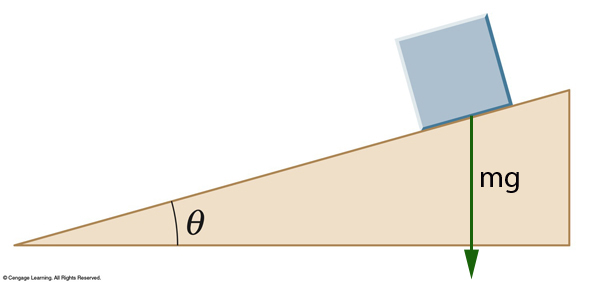
What about something a bit more, how shall I say, convoluted? You cannot do any sort of analysis on this image.
Why not?
Please converse -- while you're at it, please do a quick force diagram before we mush on.
The answer is that we don't know anything about the motion (specifically the VELOCITY) of the mass.
What must be happening if the box's velocity is increasing?
Work with your team to show that in a force diagram
No please do an N1VN2analysis <in writing if you please!>
What must be happening if the box's velocity is decreasing?
Work with your team to show that in a force diagram
No please do an N1VN2analysis <in writing if you please!>
What must be happening if the box's velocity is stays the same?
Work with your team to show that in a force diagram
No please do an N1VN2analysis <in writing if you please!>